Should I Import a Car From Japan or the UK?
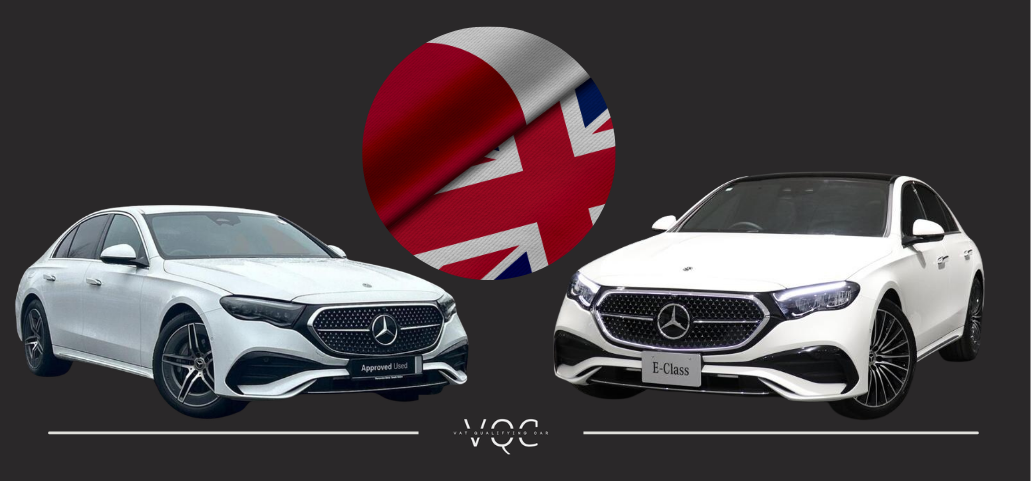
UK Mercedes or Japanese Mercedes?
If you're looking to import a prestige car into Ireland, two routes keep coming up in conversation: Japan and the UK. Both have their advocates. Both can deliver the car you want. But for most buyers, they are not equal options and the differences go well beyond price.
This guide breaks down what you actually need to know before making that decision.
Why Consider Importing From Japan?
Japan has a well-earned reputation for producing high-quality, well-maintained vehicles. JDM (Japanese Domestic Market) cars often have lower mileage, have been driven in good road conditions, and are generally well looked after. For certain models that aren't available, or are hard to find in the UK, Japan can be a good sourcing option.
The price point is also part of the appeal. Japanese imports can appear cheaper than equivalent UK cars, and that difference is visible enough to catch the eye of a buyer doing initial research.
However, the price comparison deserves a closer look. Japanese cars frequently come in at a lower spec to achieve that price. The model may look the same on paper, but the trim level, technology package, or optional extras are often different; sometimes significantly so. A buyer comparing a Japanese price to a UK price may find themselves comparing two very different cars. If the car that arrives doesn't have the spec you were expecting, that initial price saving starts to look much less attractive.
The UK VAT Saving
This is the financial argument that changes everything.
Post-Brexit, the UK sits outside the EU. That means cars sourced in the UK and exported to Europe can be purchased free of UK VAT, a 20% saving on the purchase price. On a £30,000 car, that's £5,000. On a £50,000 car, that's £8,3332 and for a £70,000 car, £11,667.
That saving reframes the UK cars as a viable import.
There's an important catch: you cannot access this saving yourself. UK dealers are required to charge VAT on sales within the UK, and the VAT reclaim process requires a VAT registered intermediary such as a professional car exporter who knows how to structure the transaction correctly. Most UK dealers won't engage with export enquiries it's complex, outside their core business, and they simply say no.
VATQualifyingCar.com exists specifically to solve this. We handle the entire process from sourcing the car, processing the VAT reclaim, managing the documentation, and shipping the car to its destination. The buyer gets their car and their saving discounted in their import price.
Lead Times: How Long Does Importing Take?
This is one of the most practical differences between the two routes, and it rarely gets the attention it deserves.
Shipping a car from Japan to Europe takes approximately six weeks but the customs processing adds another one to two months. That means committing to a car and waiting for 4-5 months before your car arrives. You are trusting that the car you bought remotely is everything it was described to be, without being able to inspect it, and you are waiting months to find out.
UK sourcing is a different reality entirely. A car purchased from the UK market can be delivered to Europe in a matter of days. You can have a car inspected, purchased, and on your driveway within a comfortable timeframe. For most buyers, the four-to-six month Japan lead time is a significant drawback financially and practically.
Spec, Language, and Service History
The specification of UK cars is very familiar. The sat nav works across European roads. The infotainment system is in English. The manuals are in English. The service history is documented in English and verifiable.
Japanese cars are built to JDM specification, which is different to EU spec in a number of ways. Radios and control systems often require conversion. Dashboard displays can retain Japanese language even after conversion work has been done something that gets passed on to the retail buyer and remains a persistent frustration throughout ownership.
Service history is also handled differently. Japanese auction cars typically come with a history sticker rather than a full documented service record. For a buyer who values knowing exactly what has been done to their car and when, this is a meaningful limitation.
UK cars also come with a full MOT, manufacturer warranty (where still within the warranty period), and two sets of keys as standard. Japanese imports typically come without manufacturer warranty, with a single key, and without an equivalent roadworthiness certification.
UK-spec vehicles also have parts readily available and relatively easy to source, but Japanese parts maybe be something of a challenge. That familiarity matters more than buyers expect, until the first time something needs fixing.
The Fuel Quality Issue
This is a long-term ownership risk that almost never comes up in the initial buying conversation, but it should.
The petrol sold in Japan is formulated to different standards than European fuel. Japanese car engines are calibrated and optimised to run on Japanese petrol. When those cars are exported and run on European fuel over an extended period, the mismatch between what the engine was designed for and what it's actually running on can cause wear and performance issues over time.
This isn't a guaranteed outcome, and it won't necessarily show up immediately. But it is a real technical consideration particularly for buyers planning to keep a car long-term, or for those buying higher-performance vehicles where engine precision matters most.
UK cars are built and tuned to EU fuel standards from the factory. There is no adjustment period, no calibration mismatch, and no long-term question mark over how the engine will respond to the fuel it's running on every day.
Sourcing Spare Parts
Japanese Domestic Market cars are built to JDM specification, which in a number of cases means different components to the UK or European equivalent. When parts are needed sourcing the correct JDM-spec components can be significantly harder, more expensive, and slower than sourcing parts for a UK-spec vehicle.
Local garages and parts suppliers are geared towards UK and EU specification cars. If a part is available off the shelf for a UK-spec vehicle but needs to be sourced internationally for a JDM variant, the difference in cost, wait time, and convenience adds up over the ownership period.
This is not a reason to avoid Japanese cars entirely but it is a total cost of ownership consideration that buyers rarely factor in at the point of purchase.
So Which Should You Choose?
The honest answer is: it depends on what you are buying.
If you are looking for a model that is genuinely rare or unavailable in the UK, a specific JDM-only variant that simply does not exist in right-hand drive European specification, then Japan may be your only route, and the trade-offs may be worth accepting.
But for the vast majority of Irish buyers looking to import a prestige car, the case for UK sourcing is clear:
The VAT reclaim closes the price gap, often eliminating it entirely, or making the UK car cheaper
Lead times are days, not months
UK spec aligns with what buyers expect; language, documentation, parts
No long-term fuel compatibility questions
Spare parts are accessible and straightforward to source
Full service history, MOT, and manufacturer warranty where applicable
A local specialist who can be held accountable and is reachable when you need them
The Japan route looks compelling at first glance. The price appears lower, the cars are well-maintained, and there is a familiarity to the brand names. But once you look past the headline figure and account for spec differences, lead times, fuel compatibility, parts availability, and most significantly the VAT saving that only applies to UK-sourced cars, the picture changes considerably.
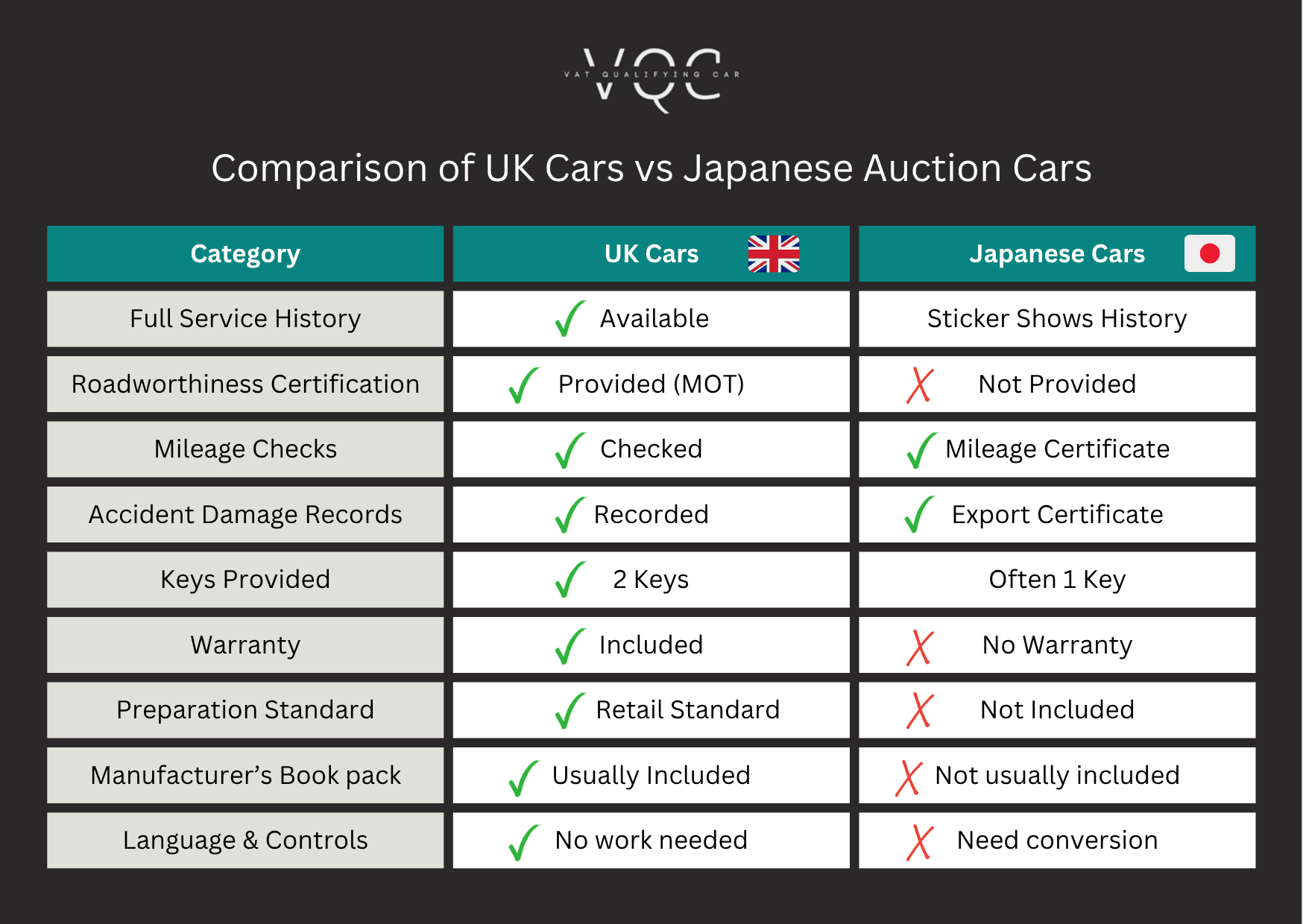
Comparison chart of UK Cars vs Japanese Cars
How VQC Can Help
As a specialist in UK car sourcing and VAT reclaim service for European buyers. We source cars from across the full UK market, handle the VAT reclaim process end to end, manage all documentation and shipping, and deliver your car to Ireland.
We have been doing this for over 17 years as part of MHH International more than 7,000 cars exported to buyers in 37 countries. Our Trustpilot reviews are public and tell the story better than we can.
If you are considering importing a car and want to understand exactly how much you could save, get in touch with our team today.